01
Produce
Changemakers for a desirable future
2025 was a year of tensions, resilience and structuring progress for our Extended Producer Responsibility (EPR) scheme for textiles and footwear.
Against a backdrop of crisis in international outlets, falling second-hand clothing prices and pressure across the entire value chain, Refashion remained fully mobilised to meet its commitments. It was precisely in this context that, together with the public authorities and all stakeholders, we launched in-depth work to rapidly evolve the framework of the EPR scheme and build the conditions for a robust, sustainable, industrial, and efficient model.
Among the highlights of the year:
The launch of the major consultation work on the redesign of the scheme, led by the public authorities, to collectively build the framework for the next EPR Clothing, Household linen and Footwear (CHF) scheme.
The mobilisation of an exceptional envelope of €49 million, fully financed by the entities placing goods onto the market, to support sorting operators in response to declining revenues and preserve processing capacities across the entire country.
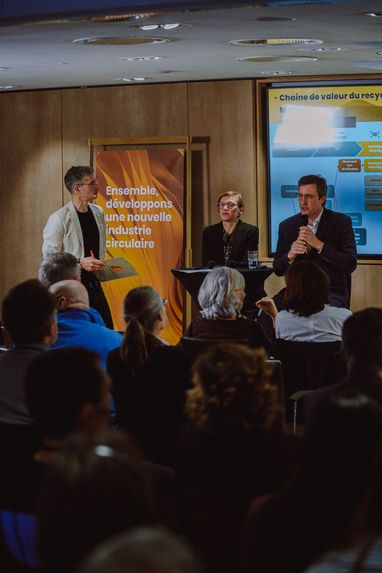
The first edition of the Recycle Summit, bringing together more than 90 stakeholders to accelerate the development of industrial outlets and structure an ambitious CHF recycling sector.
The strengthening of the free take-back system, placed under severe strain by the withdrawal of certain buyers from summer 2025 onwards, with the triggering of an emergency procedure to guarantee service continuity across the entire country.
The Tissu de Vérité pop-up, an unprecedented immersive and educational initiative in the heart of Paris, led by Jamy Gourmaud and Daphné Burki, to durably embed the right citizen reflexes.
A 121% increase in the number of items declared under eco-modulations, confirming the growing impact of this key lever for embedding eco-design in brand practices.
2025 reminded us that the environmental transition does not follow a linear path. It requires resilience, cooperation and a long-term vision. This conviction guides Refashion’s action: to build, alongside all stakeholders in the sector, in a spirit of dialogue and shared responsibility, a more resource-efficient, more circular and more sovereign textile and footwear model.
We are all pursuing the same objective: to enable citizens to donate their textiles and footwear under the best possible conditions, and to build together the sustainable solutions that the sector needs.
Didier Souflet, Chairman of Refashion
Maud Hardy, Chief Executive of Refashion
For every €100 of eco-fees :
Source : Refashion, 2026 Budget
36€
Financial support for sorting operators and operational activities.
Know more20€
Bonuses paid and penalties invoiced to marketers to encourage the most virtuous ecodesign initiatives.
12€
Financing for the Repair Bonus and actions promoting the development of textiles and footwear repair.
8.5€
Financing of actions and projects promoting the development of the reuse of textiles and footwear.
6.5€
Supporting the proper functioning of the eco-organization and the management of various programs.
5€
Financing new automated sorting, preprocessing, recycling and waste recovery solutions.
5€
Public communication actions to promote waste prevention.
4.56€
Development of tools and programs for monitoring stakeholders in the industry.
2€
Financial support provided to local authorities to contribute to their communication initiatives aimed at developping the collection of used clothing, household linen and footwear.
0.5€